Article published in Informations Entreprise no. 198
From cancer research to executive coaching — how do you explain that journey?
The common thread is my passion for people. In fundamental research, I was too far from the patient, and the pressure to publish didn’t suit me – I wanted to beat cancer, not win a Nobel Prize. Then, I spent more than fifteen years at bioMérieux, leading teams, sites and complex projects. Covid cut me off brutally from human connection, and that break was a revelation: what I truly wanted was to help people grow. That’s how REVEALIS was born.
What is REVEALIS’s promise to companies today?
To reveal talent. We hold a deep conviction: everyone has value. Our role is to help individuals become aware of it and find their right place within an organisation, so they can unlock their full potential. We work on two main areas: advancing women’s careers and developing team potential. With one clear goal: building lasting performance through collective intelligence.
How do you put people at the heart of strategy without slowing down economic performance?
There is no company without people. And there is no performance without caring for them. The model focused solely on results is over. Employee well-being, support and development are now the first building block of any business strategy. Enduring organisations are those that invest in their human wealth. People are not a nice-to-have — they are a strategic asset.
“Caring for people is not superficial. It’s not saying hello in the corridor. It’s a genuine managerial intention, a culture.”
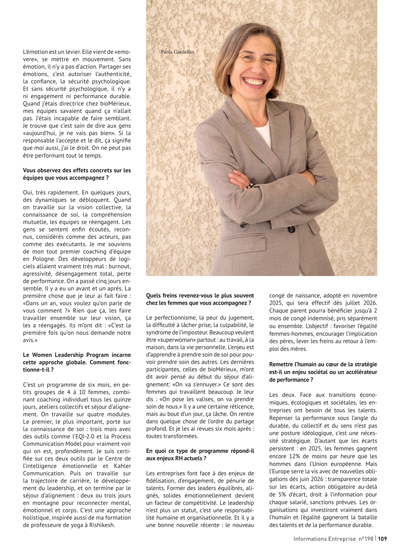
— Paola Gardellin, founder of REVEALIS
You often talk about “human wealth” rather than “human resources.” Why?
Because a company is first and foremost made of people, not functions. Caring for people is not superficial. It’s not saying hello in the corridor. It’s a genuine managerial intention, a culture. Without it, there is no lasting performance — only short-term productivity.
In what way does women’s leadership act as a lever for lasting managerial transformation?
Leadership is a stance, not a gender. But women often bring a more purpose-driven, relational, human-centred approach, while traditional models tend to focus heavily on objectives and career advancement. Yet younger generations need meaning to commit. That’s where women’s leadership becomes a powerful driver of managerial transformation. The data supports this: McKinsey found that having women in executive committees increases return on equity by 47% and operating results by 55%.
Key figures
+47%
Return on equity with women in executive committees (McKinsey)
+55%
Operating results (McKinsey)
30%
Only 30% of junior women report a promotion in the last 2 years (vs 43% of men)
–12%
Gender pay gap in the EU (2025, per hour)
What structural barriers still limit women’s access to leadership positions?
They are multiple: stereotypes, cognitive biases, work organisation, impostor syndrome, mental load. And above all, a glaring lack of sponsorship. Junior women are roughly twice as unlikely as men to have a senior sponsor – the kind of person who can truly influence their advancement. As a result, only 30% of junior women report having been promoted in the last two years, versus 43% of men. Nothing changes until gender balance is treated as a strategic priority by leaders. The French Rixain Act now requires 30% of women in executive bodies by 1 March 2026 and 40% by March 2029 for companies with more than 1,000 employees. This is no longer activism — it has become a legal obligation.
How do you identify, support and accelerate high-potential women internally?
Through a genuinely structured HR policy: measurable targets, talent pools, career-tracking dashboards, mentoring, coaching, and individualised support. You have to build pathways — you can’t simply wait for talent to emerge on its own. The professional equality index, mandatory for all companies with more than 50 employees, is an excellent starting point. It measures pay gaps, the distribution of raises and promotions, pay increases on return from maternity leave, and gender parity among the highest earners. With a score below 75, companies must publish corrective measures — or face a penalty of up to 1% of payroll. These tools exist — you just have to use them seriously.
What role should diversity of leadership styles play in collective performance?
A central one. The more diverse the styles, the stronger the collective intelligence. Coaching leadership, strategic leadership, visionary leadership, empathic leadership — this diversity is a strength. It allows organisations to adapt better, innovate better, decide better.
You advocate for proactive coaching, not reactive coaching. Why?
Because management is a skill that can be learned. We still too often call in a coach when there’s a crisis, a conflict, a team in difficulty. Coaching should be used from the moment of a promotion, a new role, or a major transformation. Prevention always costs less than repair.
“Emotion is a lever. It comes from ’emovere’ — to set in motion. Without emotion, there is no action.”
— Paola Gardellin, founder of REVEALIS
Emotion is still often seen as a weakness in business. You say the opposite.
Emotion is a lever. It comes from “emovere” — to set in motion. Without emotion, there is no action. Sharing emotions means allowing authenticity, trust and psychological safety. And without psychological safety, there is neither engagement nor lasting performance. When I was a director at bioMérieux, my teams could tell when something was wrong. I was incapable of pretending. I think it’s healthy to say to people: “Today, I’m not doing well.” If the person in charge accepts and says it, it means others have the right to say it too. No one can be on top form all the time.
Do you see concrete results in the teams you work with?
Yes, very quickly. Within a few days, dynamics shift. When we work on shared vision, self-awareness and mutual understanding, teams re-engage. People finally feel heard, recognised, seen as contributors rather than just executors. I remember my very first team coaching in Poland. Software developers were in a very bad place: burnout, verbal aggression, complete disengagement, loss of performance. We spent five days together. There was a before and an after. The first thing I had them do: “In a year’s time, how do you want people to talk about you?” Just that — getting them to work together on their vision — re-engaged them. They told me: “This is the first time anyone has asked for our opinion.”
The Women Leadership Program embodies this holistic approach. How does it work?
It’s a six-month programme, in small groups of 4 to 10 women, combining individual coaching every two weeks, group workshops and an alignment retreat. We work through four modules. The first — and most important — focuses on self-knowledge: three months using tools like the EQI-2.0 and the Process Communication Model to truly understand who you are, at a deep level. I am certified in both tools by the Centre for Emotional Intelligence and Kahler Communication. Then we work on career trajectory, leadership development, and finish with the alignment retreat: two or three days in the mountains to reconnect mind, emotions and body. It’s a holistic approach, also inspired by my training as a yoga teacher in Rishikesh.
What are the most common barriers you see in the women you work with?
Perfectionism, fear of judgement, difficulty letting go, guilt, impostor syndrome. Many want to be “superwoman” everywhere: at work, at home, in their personal lives. The challenge is learning to take care of yourself so you can take care of others. The most recent participants — from bioMérieux — told me they had thought: “We’re going to be bored.” These are very driven women. I told them: “We’re putting the bags down. We’re going to take care of ourselves.” There’s initial resistance, but within a day, something releases. We enter a space of deep sharing. I saw them again six months later: all transformed.
How does this type of programme address current HR challenges?
Companies are facing retention, engagement and talent shortage challenges. Developing balanced, aligned, emotionally resilient leaders is becoming a competitive advantage. Leadership is no longer a status — it’s a human and organisational responsibility. And there’s good news: France’s new parental leave reform, adopted in November 2025 and effective from July 2026, gives each parent up to 2 months of paid leave, taken separately or together. The aim: promote gender equality, encourage fathers’ involvement, and remove barriers to mothers returning to work.
Is putting people at the heart of strategy a societal issue or a performance accelerator?
Both. Faced with economic, ecological and societal transitions, companies need all the talent they can get. Rethinking performance through the lens of sustainability, collective intelligence and purpose is not an ideological stance — it’s a strategic necessity. Especially given that gaps persist: in 2025, women still earn 12% less per hour than men across the European Union. But Europe is tightening the rules: from June 2026, new obligations will require full transparency on pay gaps, mandatory action beyond a 5% gap, individual rights to pay information, and sanctions for non-compliance. Organisations that genuinely invest in people and equality will win the battle for talent and lasting performance.